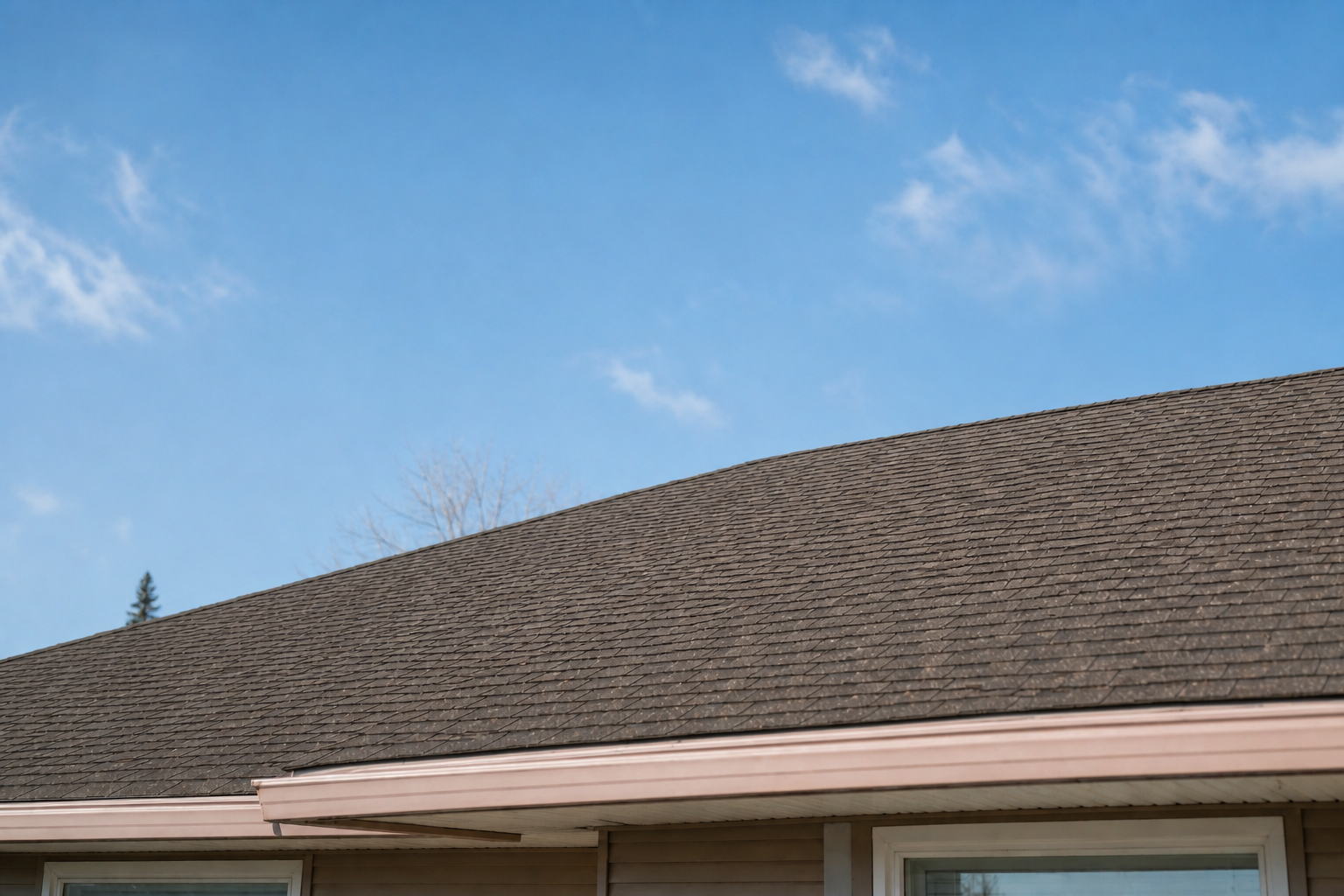
Why hail damage hides
Hail does not usually punch a hole through a shingle. It bruises the mat underneath the granule surface, which means the shingle can look completely intact from a distance while the layer that actually sheds water has already cracked. That bruise gets worse every time the sun heats the roof and the shingle expands and contracts around the weak spot, until eventually it fails at that exact point.
The granules themselves tell part of the story too. A hard hail hit knocks granules loose in a scatter pattern, and you will often find a small pile of them in the gutter after a storm even when the shingles above look fine. That granule loss exposes the asphalt underneath to direct sun, and that shingle ages faster than the ones around it from that point forward on.
Where to look, if you look yourself
Soft metal is the easiest early clue. Roof vents, gutter caps and window screens dent more easily than shingles do, so if you see fresh dimples in those, it is worth assuming the roof took a similar hit even if the shingles look untouched. Air conditioning fins on an outdoor unit are another soft metal surface that shows hail damage clearly and quickly.
We do not recommend climbing onto your own roof after a storm. A wet or debris covered roof is a bad place to be checking for damage, and the soft metal clues on the ground tell most of what you need to know before deciding whether a closer inspection is worth scheduling at all.
Why timing matters with insurance
Most policies have a window for filing a storm damage claim, and that window starts from the date of the storm, not from the date you happen to notice a leak. Hail damage that goes unreported for months can be harder to tie to a specific storm event, since more than one system may have passed through by the time an adjuster looks at it. An inspection soon after a storm gives you a documented baseline either way.
That documentation matters even if you decide not to file right away. Photos and a written inspection report dated close to the storm give you something concrete if a slow leak shows up later and you need to connect it back to that particular event.
What we do differently on a hail inspection
We check the soft metal first, then walk every slope of the roof itself, then look at the gutters for granule buildup. Each of those checks either confirms or rules out hail impact, and we photograph all three so the final report is not just our word about what we happened to see up there.